Racine, WI · Garage Door Service
Why a Door Goes Off Track - A Racine Perspective
Racine's 1960s-70s housing stock and cold winters put extra strain on garage door track. Here's what actually knocks a door off, what to check first, and what repair costs.
- Repairs & new doors
- Springs & openers
- Serving 4 nearby communities
How Local Conditions Play In
Most of the garage doors we open in Racine sit on houses built between 1957 and 1994, with the bulk of that stock going up in the 1960s and 70s across the eighteen neighborhoods we cover - from Mount Pleasant and Wind Point four miles out to Franklin and Muskego closer to twenty. That matters for track because builders in that era hung steel and aluminum rail on lighter brackets than what ships today, and a lot of those brackets have never been swapped.
Racine's winters are the other half of it. We're in a cold climate band here, not an extreme one, but enough freeze-thaw cycling every year to work a track loose at the lag bolts, especially where the original wall jamb has shrunk or shifted over four or five decades. A track that's a quarter-inch out of plumb doesn't look wrong to the eye. It just means the rollers ride the edge of the rail instead of the center, and eventually they walk right out of it.
None of this is dramatic. It's slow wear on old hardware in a climate that never lets the metal sit still.
The Problem
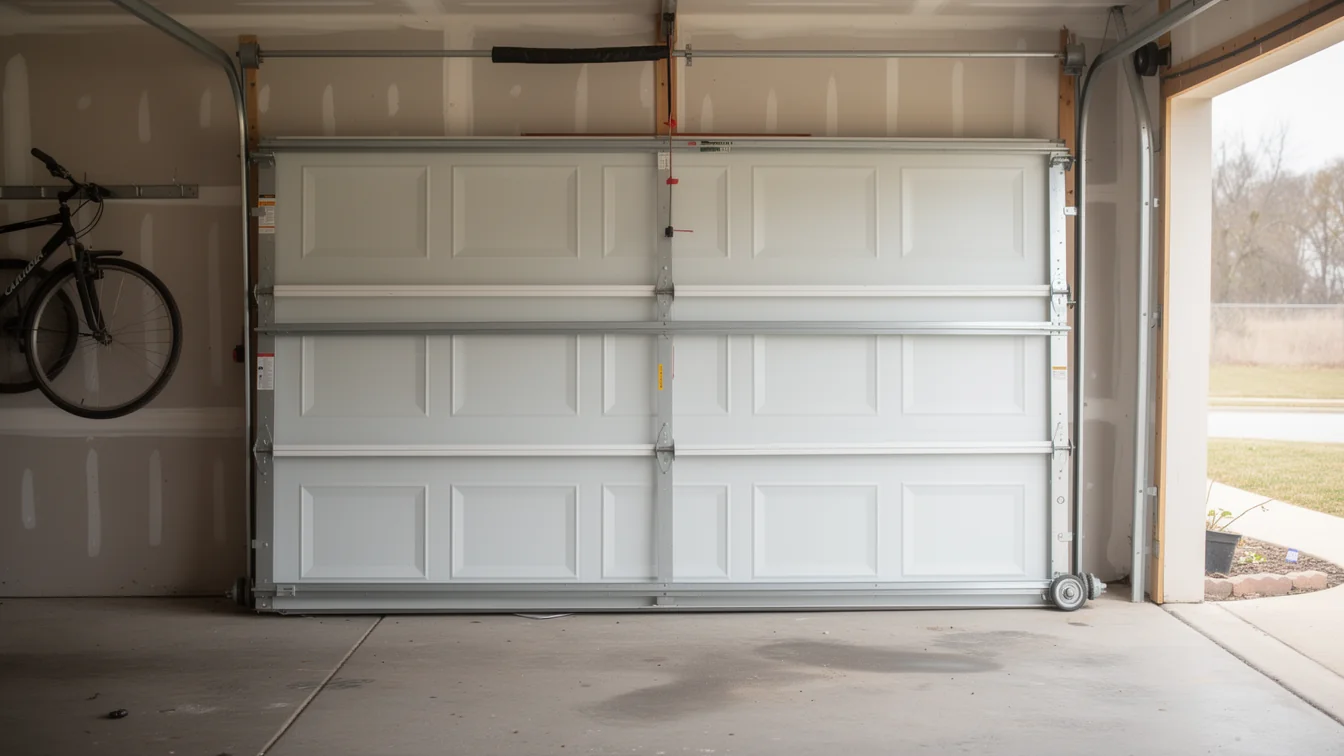
A door goes off track one of a few ways, and the age of the house usually tells you which. On the older end of our housing stock - the 1957 to mid-1960s builds - we still find original track with hanger brackets that have worked loose from the framing over the years. Once a bracket shifts even slightly, the whole rail twists, and the rollers stop tracking straight.
On the 1970s-era doors, the more common culprit is a broken cable or a snapped spring on one side. The door lifts unevenly, one corner drags against the track, and the roller pops free of the rail. This is different from a bracket problem and it needs a different fix - you don't just push the door back on the track and bolt the bracket tighter, because the door will come off again within days.
Less often, it's a bent section of track itself, usually from a car bumper or a stored bike leaning against it. That one's obvious once you look, but it's the one homeowners try to bend back by hand, which usually makes the rail worse, not better.
What To Look At First
Before you call anyone, look at three things. First, the track itself - stand at the side of the door and sight down the rail from bottom to top. Any kink, any spot where it bows away from the wall, is a flag. Second, check whether the door is lifting level. If one side rises before the other, you're looking at a cable or spring problem, not a track problem, even though the door may end up off the rail either way.
Third, look at the rollers where they sit in the track. On houses from our 1960s-70s stock, original rollers are often the small nylon type that wears a groove and gets loose in the channel over time. If you can wiggle a roller side to side inside the rail by more than a little, that roller - and probably its neighbors - is due.
Don't try to force the door back onto the track yourself if a spring is involved. A door under spring tension that comes off the rail can drop fast, and that's not a DIY moment. Get it looked at before you touch the cables.
What You Pay
What a repair runs depends on which of those three problems you've actually got. A bracket that's worked loose from the wall is a straightforward fix - re-anchor it, true up the rail, done. A bent section of track usually means replacing that section rather than trying to straighten it, since bent aluminum or steel rarely sits flat again once it's kinked.
If the door came off track because a cable snapped or a spring broke, the track repair is really a side effect - the spring or cable is the job, and the track just gets reset once that's sorted. That's a different scope of work and a different bill than a loose bracket.
We don't quote a number sight unseen, because a house from our 1970s stock with original hardware and no prior repairs is a different job than a house where someone's already swapped half the parts. One honest limitation: if the track is bent in more than one place or the jamb framing behind it has shifted, patching the rail is a short-term fix - at that point replacing the track section is the better use of your money, even if it costs more up front.
Frequently asked questions
Can I push the door back onto the track myself?
Not if a spring or cable is involved - the door can drop fast under tension and that's a real injury risk. If it's a simple roller that popped out with the door otherwise sitting still and unlocked from the opener, it's lower risk, but we'd still rather you call and ask first than guess.
Is this a problem with my specific house or just older houses in general?
In Racine it tracks closely with the age of the housing stock. Most of what we see is in houses built from the late 1950s through the 1970s, which is a large share of homes across this service area, so original brackets and track are common, not unusual.
Why does this seem to happen more in winter?
Cold cycling causes the track and the framing it's bolted to expand and contract. Over enough winters that movement loosens lag bolts and shifts brackets slightly out of plumb, which is exactly the kind of wear that shows up in our climate on older hardware.
How do I know if it's the spring and not the track?
Watch the door lift. If one side comes up faster than the other, or the door looks tilted partway up, that's a spring or cable problem, not a track problem - even though the door may end up riding off the rail either way.
Related garage door services in Racine
More garage door guides
Book garage door service in Racine
Call now or request a quote - tell us what the door is doing and where you are.