Racine, WI · Garage Door Service
Is Your Racine Garage Door Worth Repairing, or Past It
Racine homes mostly date 1957-1994. Here's how to tell if your garage door's original hardware is worth repairing or if it's time to replace it.
- Repairs & new doors
- Springs & openers
- Serving 4 nearby communities
How Local Conditions Play In
Most of the housing stock around Racine went up between 1957 and 1994, with a median build year around 1975, and that era shows up on nearly every service call we run across the area's 18 named neighborhoods. Doors from that stretch were often hung with steel torsion springs rated for a 10,000-cycle life, which sounds like a lot until you realize a door used twice a day for 40-plus years has already burned through that number more than once. The cold moderate climate band we sit in doesn't help. Winters bring enough freeze-thaw cycling that steel rollers pit, track brackets loosen as wood jambs shrink and swell, and the lubrication on older spring coils gums up or dries out depending on the season. None of that is damage you can see from the driveway. A door can look fine and still be running on hardware that's one cold morning from letting go. If your house falls in that 1957-1994 build window, the question isn't whether the original hardware has aged - it's how far along that aging is.
The Problem
Doors installed during that build era were made to a different standard than what goes in today. Panels were often thinner steel or raw wood, tracks were narrower gauge, and the openers - if the door even came with one - used worm-gear drives that chatter and lose timing after a decade or two. We see a lot of Racine-area garages where the door itself is structurally fine but the spring, cable, and roller assembly around it has been patched piecemeal over the years: a roller swapped here, a cable spliced there. That patchwork approach can keep a door limping along, but it also means the parts on it are a mismatched set, which makes diagnosing a new noise or a stuck track harder than it should be. The honest answer is that a door from this era isn't automatically a write-off - but it's also not something you keep repairing indefinitely just because the panel still looks straight.
What to Look At First
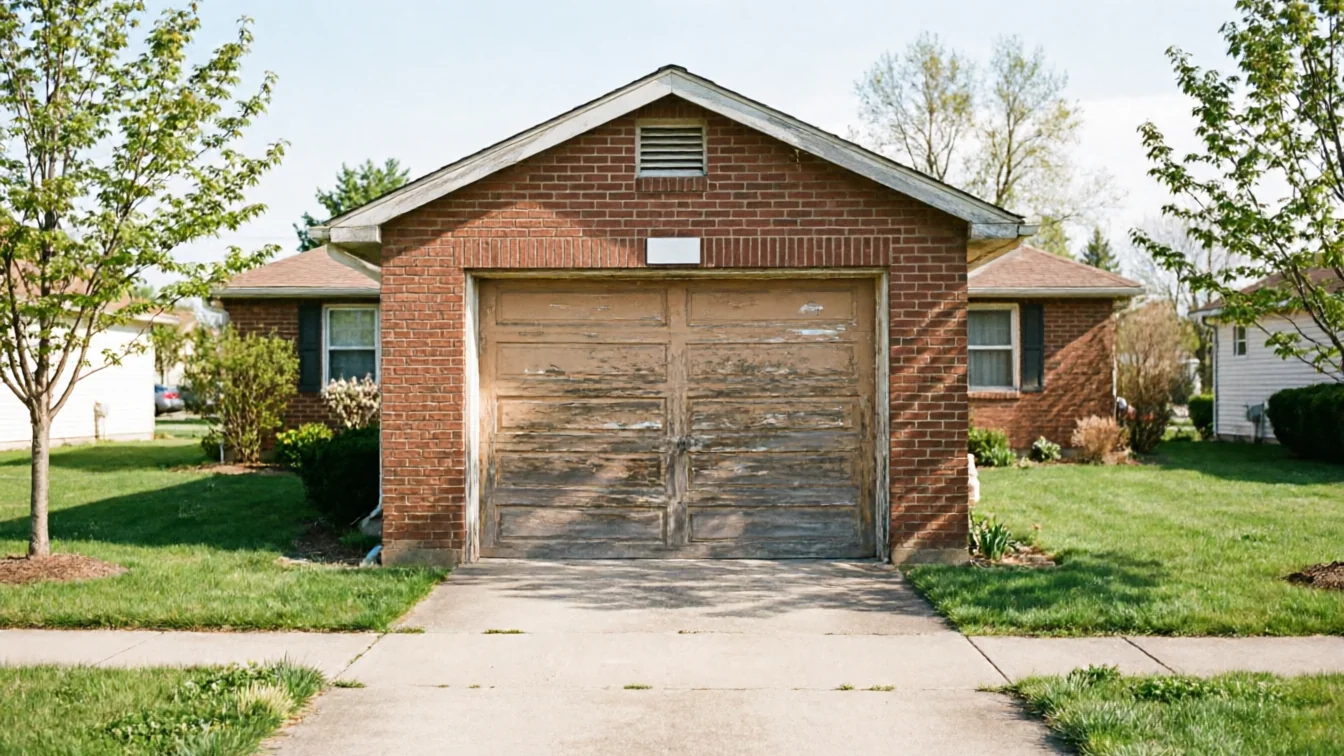
Start with the panels, not the opener. If the door is wood or an early steel design from the 1957-1994 build window, check for rust-through at the bottom panel and delamination at the corners - that's structural, and no amount of spring or roller work fixes it. Next, look at the track alignment; on houses this age, decades of minor foundation settling can leave tracks slightly out of plumb, which shows up as a door that binds partway through its travel. Then check the spring itself. A torsion spring with visible gaps stretched between coils, or one that's clearly been re-wound with mismatched wire, is near the end of its service life regardless of how the door looks otherwise. Last, test the opener's force settings - worm-drive units from this era rarely have the auto-reverse sensitivity that current code expects, and that's a safety issue more than a convenience one. If the panels and track are sound and it's really just spring, cable, or roller wear, that's a repair. If the frame's racked or the panel's rotted through, that's a replacement conversation.
What You Pay
We don't post a flat price list here because the two biggest cost drivers - whether you need one spring or two, and whether the track needs realignment along with it - only show up once we're looking at the door in person. What we can tell you is how we think about it: on a door from the 1957-1994 stock common around Racine, a spring and roller job is usually the right call if the panels and track are sound, since replacing just the worn hardware costs a fraction of a full door swap. Where it stops making sense is when the track is bent, the panel's rusted through, or the opener predates current auto-reverse requirements - at that point you're paying repair money toward a door you'll still need to replace in a year or two. We'll tell you straight which category your door falls into before we start any work, not after.
Frequently asked questions
My house was built in the 1970s - is the original garage door hardware still safe to use?
Not usually. Torsion springs from that era are well past their rated cycle life by now, and worm-drive openers common in 1970s construction often lack the auto-reverse sensitivity current safety standards call for. We check both on any older Racine-area door before recommending repair over replacement.
Why does my garage door act up more in winter?
Racine sits in a cold moderate climate band, and the freeze-thaw cycling affects steel rollers, track brackets, and spring lubrication differently than it would somewhere warmer. A door that runs fine in July can bind or groan in January simply from the hardware contracting and the lubricant thickening.
How do I know if it's cheaper to repair or replace?
If the panels and track are structurally sound and the problem is a worn spring, cable, or roller, repair almost always costs less than replacement. Once the track is bent or the panel's rusted through, you're better off putting that money toward a new door instead of patching an old one.
Related garage door services in Racine
More garage door guides
Book garage door service in Racine
Call now or request a quote - tell us what the door is doing and where you are.